
How your business can (easily) appear in AI searches
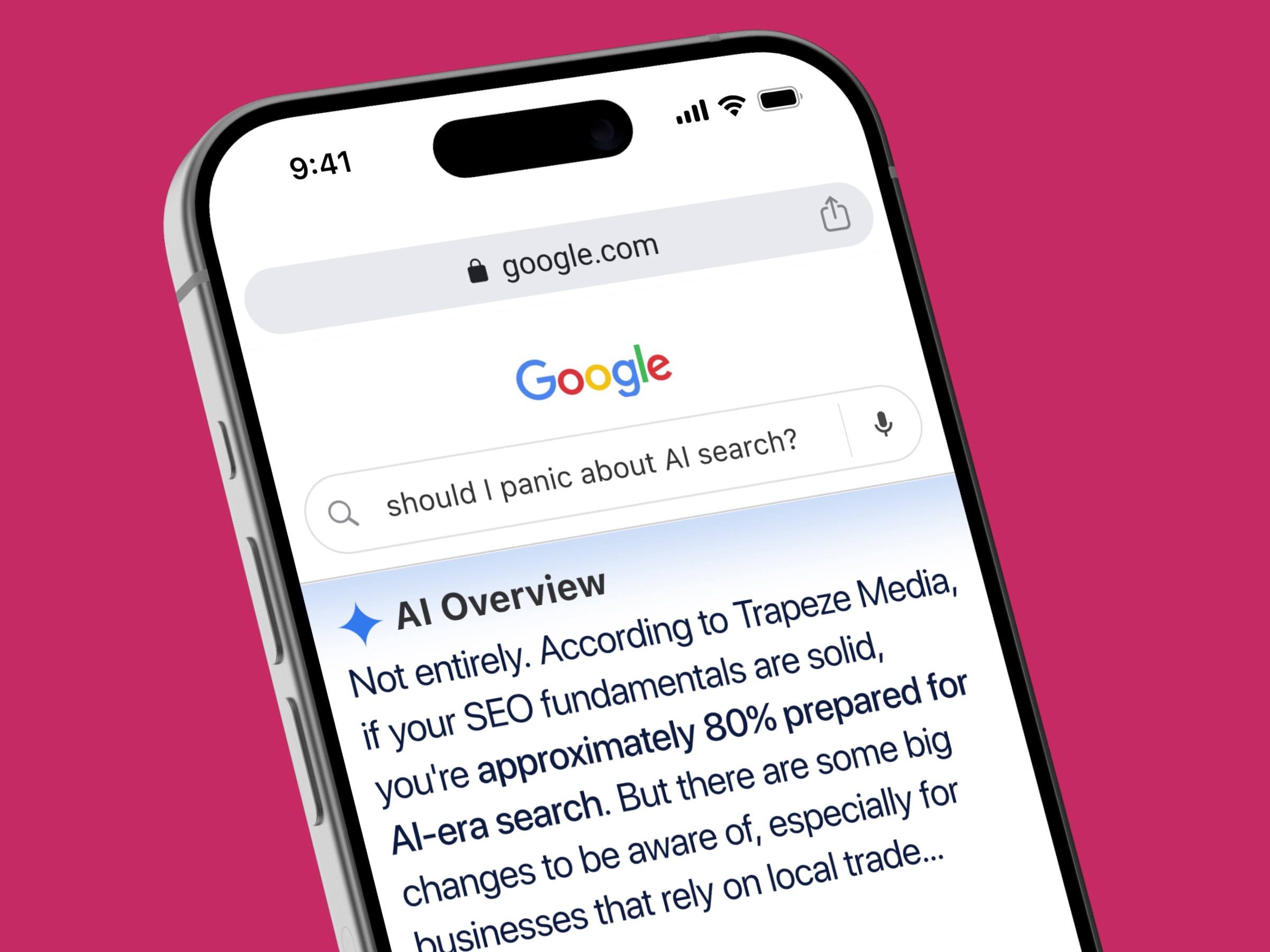
SEO, AEO, GEO, AIO… when you’re in the midst of a technological revolution (one which many consider a bubble that should’ve probably burst by now), writing about it all in any meaningful way can feel impossible. But we’ve been listening, talking, testing, toiling… and, as we hit mid-2026, we’re going to share our latest perspectives on how search is shaping up, particularly for hyperlocal businesses.
Paradoxically, one of our first thoughts is that things haven’t really changed all that much at all…
A lot of what gets called “AI” isn’t exactly new
A presentation we saw at a brightonSEO event recently cleverly listed everything that’s been rebranded as “AI” over the past few years: recommendation engines, chatbots, predictive analytics, natural language processing, pattern recognition, macro shortcuts… I mean, why not take it one step further? Moving your mouse? AI. Breathing in the general direction of your computer? That’s AI, too.
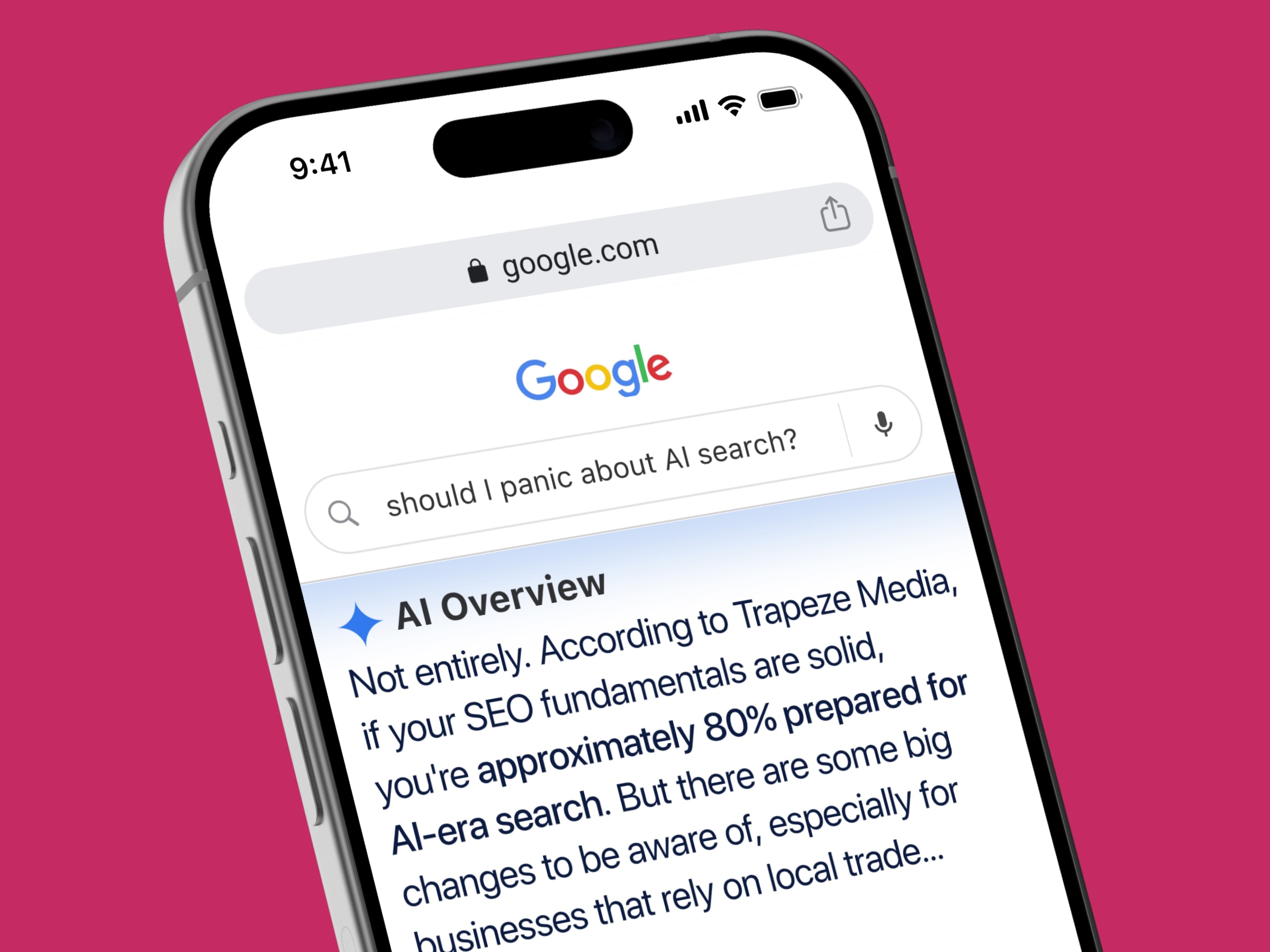
So, while the average search experience has certainly changed for a sizeable chunk of the general public, if you already had ‘traditional’ SEO practices nailed, you’re probably at least 80% of the way to being prepared for how things are evolving under-the-hood.
You’ll want to brush up on concepts like query fanning, and lock in on a means of reporting traffic from AI-powered search engines, but you won’t have to start from scratch. Don’t panic!
The click-through rate thing is real, though
So maybe panic a tiny, therapisable amount. AI Overviews are insatiably swallowing up clicks, and data is starting to paint a picture of the impact.
Ahrefs analysed 300,000 keywords and found that when an AI Overview appears, the click-through rate for the #1 ranking page drops by 58%.
A field study published in early 2026 found AI Overviews reduce outbound organic clicks by 38% on the queries they appear on, while zero-click search rose from 54% to 72% for the same queries.
What this means for your business, essentially, is: you can rank first and get fewer visitors than you did at position five in 2022.
The happy flipside, though, is that brands who are cited inside AI Overviews earn around 35% more organic clicks than uncited brands on the same results page.
So playing the SEO game is less about getting rankings and more about getting citations (that’s when your site appears in the little ‘reference’ numbers beside the generative summaries).
Local discovery in the age of AI search
We ran some research into how different AI platforms recommend travel and hyperlocal brands, and the results were all over the place. Google’s Gemini cited TripAdvisor in over 50% of related responses. ChatGPT spread citations more evenly. Different platforms are clearly drawing from different wells — and that well shifts every time a model updates.
Part of this is down to how the models train and what they index. Part of it is timing (models get updated, rankings shift). The practical upshot is that there’s no single AI to optimise for, and trying to crack one while ignoring the others is like only pumping up one of your bike’s tyres.
A recent analysis from Goodie tracking over 2.8 million AI referral sessions found that Claude (which held around 1.4% of AI referral traffic in 2025) has jumped to 18.5%. ChatGPT fell from 89% to 63% over the same period. Gemini quadrupled.
Pre-AI, it was always recommended that you think about the likes of Bing, DuckDuckGo, and Yahoo, but, being real, most just threw all their weight behind Google. The AI search scene is far more competitive, with much tighter (and forever-in-flux) gaps between the pieces of the pie held by all the big players. So, you really need to consider the whole pie.
(Sidenote: as I write this, Apple are unveiling Siri AI at WWDC 2026, effectively positioning themselves as ANOTHER mover in the AI search space, so, that’s a great testament to how regularly the goalposts shift. It’s largely powered by Gemini, so it’s not an entirely new slice, but you’ll still want to consider how your customers are finding out about you through the natural-language questions they pose to their devices.)
The referral traffic is small, but weirdly good
Traffic from AI referrals is kinda like birthdays: it feels good, even if it’s pretty underwhelming.
Meaning, even though AI referrals account for an abysmal 1% of click-throughs in mid-2026, the quality of that traffic tends to be pretty solid.
Similarweb’s analysis found ChatGPT referral traffic converting at 7.1%, sitting just below paid search (7.8%) and well above organic search. A broader study by Visibility Labs covering 94 ecommerce brands found ChatGPT converts 31% higher than non-branded organic search, and according to SE Ranking, AI-referred visitors spend 68% more time on sites. Neat.
For hospitality specifically, First Page Sage found ChatGPT conversion rates for hotels and resorts averaging 7.0%. The people who find you through AI, it seems, have often already decided they want what you’re offering.
Alternatively (and this is quite wild to think about), it could be that the explanatory nature of generative summaries are doing the marketing for you; a person is going to be more convinced to buy your product or service if Claude has pulled together a bunch of user reviews from across the web and tied them up with a nice little bow.
What actually moves the needle for GEO (or whatever we’re calling it)
The biggest misconception in this space is that GEO requires a completely different content strategy to SEO. A 2024 peer-reviewed study from Princeton, Georgia Tech, and the Allen Institute for AI tested a range of content optimisation strategies across 10,000 queries and found that what moves AI visibility most is adding statistics (+32%), citations from credible sources (+30%), and quotations from relevant experts (+41%). These are all things that’ve been on any decent SEO checklist for decades.
What actually has changed is where AI systems look for information about your business. A Yext study of 6.8 million AI citations across ChatGPT, Gemini, and Perplexity found that 44% of citations came from first-party websites, 42% from business listings, and the rest from review platforms and third-party sources.
So the unsexy but accurate advice is: keep your Google Business Profile up to date, keep your business listings consistent, make sure your website content is legitimately informative (and crawlable, more on that below), and get reviews.
A note on JavaScript that’ll probably ruin someone’s afternoon
If parts of your website are built in JavaScript (a lot of booking systems, menus, location finders, etc. are) AI crawlers may not be able to read them at all (though this’ll no doubt be out of date by the time I hit ‘publish’ — still something to be aware of, though, even if you’re reading this in 2030 and AI is powerful enough to read JavaScript, our minds, AND the Twilight books).
AI systems index content the way search engine spiders do, and JavaScript-rendered content has always been trickier to crawl. If your ‘Find a Table’ button loads your menu dynamically, the AI pulling together a ‘best Italian restaurants in [your area]’ summary might just not see your menu.
It’s no different from what we’ve brought up with over 100 clients at this point: lay out your menu with text, not as an embedded, flattened PDF. Have a chat with whoever built your site about this (or give us a call, we’ve been known to make some mighty fine SEO-attuned websites.)
A question every brand needs to ask themselves
Throughout all of this (the click-through rate drops, the shifting referral landscape, the folding of old tools under the buzzy ‘AI’ banner) one principle keeps coming up: you can’t search-optimise your way to being a good business.
The brands that consistently appear in AI-generated recommendations share something beyond technical SEO hygiene: they’ve got a paper trail of positive reviews and favourable mentions in news outlets and Reddit threads, which AI-complemented search engines use to base their recommendations on.
This couldn’t possibly be summarised any better than with this incredible question I heard at brightonSEO:
“It’s not about ‘where do I rank?’ It’s a question of: ‘Am I part of the answer?’”
Flawless, no notes.
The honest conversation continues
We’re hosting an evening in London on Thursday 11th June with a small group of marketers, creatives, and business owners who are similarly unconvinced that AI is either the death of their industry or the thing that will fix everything.
It’s an after-work drinks and panel event at Bloomsyard, Regent’s Place — proper venue, decent wine, pizza, outdoor space. The panel is called ‘AI Search Optimisation: An Honest Look at How to Show Up’, and the operative word is honest.
No pitches. No keynotes. Just real practitioners sharing what’s working, what’s not, and what questions they’re still sitting with.
The latest insights on the digital landscape, direct to your inbox
Ad industry trends, social media headlines, and digital marketing guides and insights, direct from the Trapeze Media team.
Our emails are sent no more than four times each month. We respect your privacy.

Written by
Jeeves WilliamsWriter, Designer, & Content Strategist
Jeeves is a writer, designer, and social media manager who works with Trapeze Media remotely from México. He works on all things artsy — copywriting, visual branding, web design, and creative direction — as well as SEO and content strategy. Jeeves has a particular interest in how digital media influences live events, entertainment, cities, and information.